
Living Shinto: How I Pray to the Kami (And Why My Rituals Have Room for Tears, Tarot, and Houseplants)
- Inari-Sama Shop

- May 27
- 3 min read
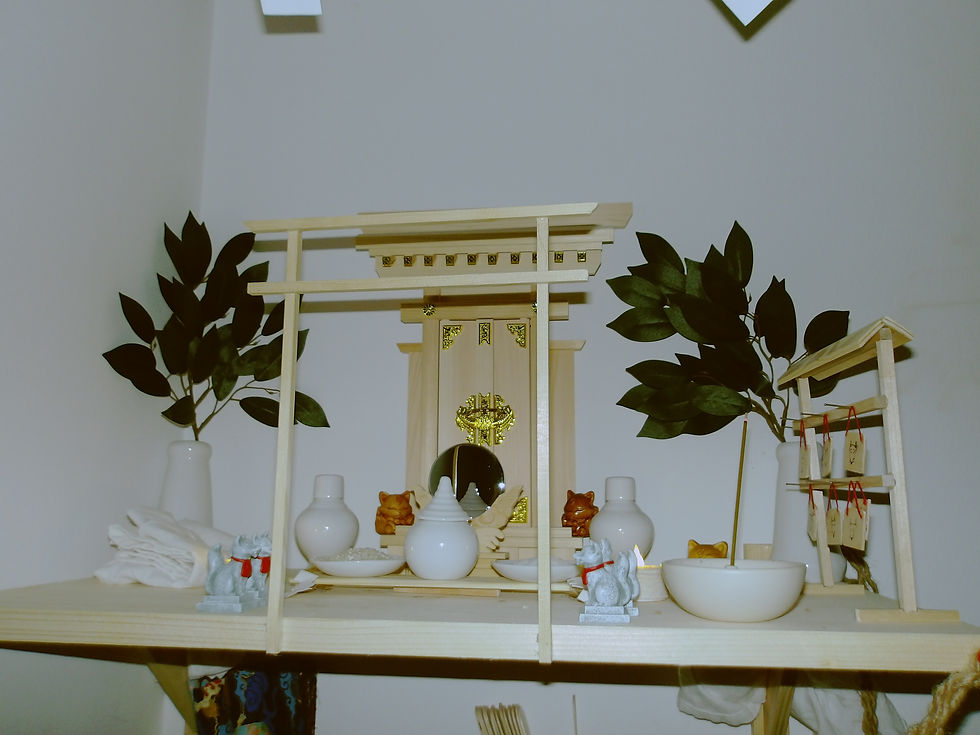
When people hear the word "Shinto," most picture majestic red torii gates in the forests of Kyoto, austere priests in white robes, and complex ancient rituals unchanged for centuries. But for me, Shinto is not frozen history. It is a living, breathing practice that unfolds every single day right in my room, by my home altar — the kamidana.
Today, I want to share how my boyfriend and I practice Shinto in our daily lives. This is a story about honoring tradition, but at the same time, about absolute sincerity and our own personal twist.
The Start of the Day: A Tradition Shared by Two

We start with the basics. Tradition demands purity, so we always perform temizu (purification of the hands and face) and approach the kamidana with clean thoughts. The ritual at the altar itself is classic: two deep bows, two claps to draw the attention of the gods, a prayer, and a final bow.
But the devil (or rather, the blessing) is in the details. Every day, my boyfriend and I bring traditional offerings to the Kami: rice, sea salt, and clean water. We share this duty: he is responsible for the rice and salt, and I take care of the water.
And this is where my first personal rule comes in: the first water of the day always goes to the Kami, not to me. Only after the gods have received their offering can I take my first sip. And what happens to the "old" water the next day? I never pour it down the drain. I give it to my houseplants. It warms my heart deeply to think that the sacred power of Amaterasu-Omikami and Inari-Sama continues to live and bloom in my home through these green leaves.
Being Yourself Before the Gods: No Rote Texts
I don't read classic norito prayers from a book. My Shinto is about relationships, and sincerity is vital in a relationship. That's why I am different every time I stand before the altar.
One day, I might come in super excited, eyes shining, eagerly telling the Kami how our business and relationship are blooming. Another day, it might be a calm chat about how the last 24 hours went. And there are days when I just come and cry because of a bad mood or exhaustion. And that’s okay. I know I don't have to be perfect. The gods see the real me.
I don't consider myself equal to the Kami; I immensely admire their majesty and energy. But at the same time, I clearly feel it: they smile back at me. They love me just as sincerely as I love them.
Prayer as Breathing
We hold an official ritual with incense at my home kamidana once a week. But in reality, I communicate with the gods constantly throughout the day. The kamidana is the center of my home, and I turn to her right in the middle of my daily routine, while doing ordinary things.
When I feel irritated or overwhelmed, I whisper: “Inari-Sama, give me strength.” When I get scared, instead of the usual "Oh my God!", “Oh my Gods!” flies from my lips, and I pray to Inari-Sama for protection and help. I don't necessarily have to stand before the kamidana — I can pray anywhere an emotion catches me, even when I'm nowhere near her. The gods hear us everywhere.
A Bridge Between Shinto and Tarot
Shinto is about seeking signs, harmony, and answers from the universe. So for me, it feels completely natural that my spiritual practice intertwines with Tarot cards. Whenever a client reaches out to me for a reading, I first turn to my kamidana, tune into high vibrations, and ask for a blessing for honest and deep insight.
In my work, I use a deck that has become a reflection of my soul — Ukiyo Tarot (which you can find in our shop, by the way). The aesthetic of the "floating world" resonates perfectly with my vision of Shinto: noticing beauty in the moment, respecting the spirits, and trusting the flow of life.
Practicing Shinto today isn't about copying medieval Japan. It’s about letting the divine into your modern everyday life, sharing duties with the person you love, watering flowers with the remnants of sacred water, and being as honest as possible before something greater than ourselves.


Comments